The Monk Doesn't Fear the Machine
There is no safe-list of AI-proof jobs — the data proves it wrong both ways. What actually protects you isn't your title, it's whether you execute tasks or direct outcomes.
Twenty-one years trading taught me to distrust the word "safe." Every blowup I've lived through, the dot-com darlings, the "can't-lose" housing bet, crypto in 2021, started as the trade everyone agreed was the smart, safe money. The crowd is heaviest right before the floor gives out.
I saw that same crowd up close over the last two months, at AI networking events in Austin and Houston. The mood in the room wasn't excitement. It was fear. Smart, accomplished professionals asking the same anxious question a dozen different ways: which careers are actually safe? What do I retrain into before it's too late?
I understand the fear. But I owe them what the market taught me, not what they want to hear. There is no safe list. There never was. And crowded is exactly what "about to break" looks like.
The Safe-List Is a Myth
Every few months a new chart makes the rounds. The "safe" jobs. The "endangered" jobs. People screenshot it, feel relief or panic, and go back to work.
Then the model updates and the chart is wrong.
We have a decade of proof now. In 2016 the "Godfather of AI," Geoffrey Hinton, told the world to stop training radiologists. Obsolete within five to ten years, he said. Completely obvious. Ten years later radiologists earn north of $570,000 a year, demand sits at record highs, and residency programs just posted their most open positions ever. The job everyone filed under "dead" is thriving.
Now flip it. A 2025 Vanguard study found the occupations most exposed to AI automation are actually outperforming the rest of the job market. The job everyone buried is thriving.
But don't mistake that for safety, because the safe-list has been just as wrong and far more costly. "Learn to code" was the canonical AI-proof advice for a decade. Then a 2025 Stanford study found entry-level employment in the most AI-exposed fields, software development and customer service leading the pack, fell roughly 13% for workers aged 22 to 25, even as headcount for older workers in the same roles kept climbing. Salesforce cut around 4,000 support jobs in a single stretch, its CEO saying AI already handles half the work. The people who followed the "safe" advice got automated first.
Read the two findings together. The jobs everyone buried are growing, and the jobs everyone recommended are shrinking. The charts don't just misfire. Sometimes they point the exact wrong direction. Copywriters, paralegals, analysts, coders: the list keeps reshuffling because the premise is broken. You cannot AI-proof a role. A role is just a bundle of tasks, and tasks are exactly what machines eat first.
Betting your security on a job title is betting that a specific bundle of tasks stays valuable and stays yours. Neither is under your control. That's not a strategy. That's a hope.
Posture Beats Title
Here's the shift almost no one makes: safety was never in what you do. It's in how you stand toward the work.
Two people hold the same title. One executes steps: takes the input, runs the procedure, hands off the output. The other directs outcomes: decides what's worth doing, judges whether the result is any good, owns the call when it's wrong.
AI replaces the first one completely. It makes the second one dangerous.
The task-doer and the outcome-director can have identical resumes. The difference isn't skill. It's posture, the stance you take toward your own work. One waits to be told what the procedure is. The other decides what the procedure should be, points the machine at it, and takes responsibility for where the ball lands.
Machines are extraordinary at execution and helpless at judgment. They'll draft the memo, write the code, run the analysis. They will not tell you whether it was the right memo, the code worth shipping, or the analysis that mattered. That gap (taste, judgment, ownership) is the whole game now. And it's a posture, not a position.
The Monk Doesn't Fear the Machine
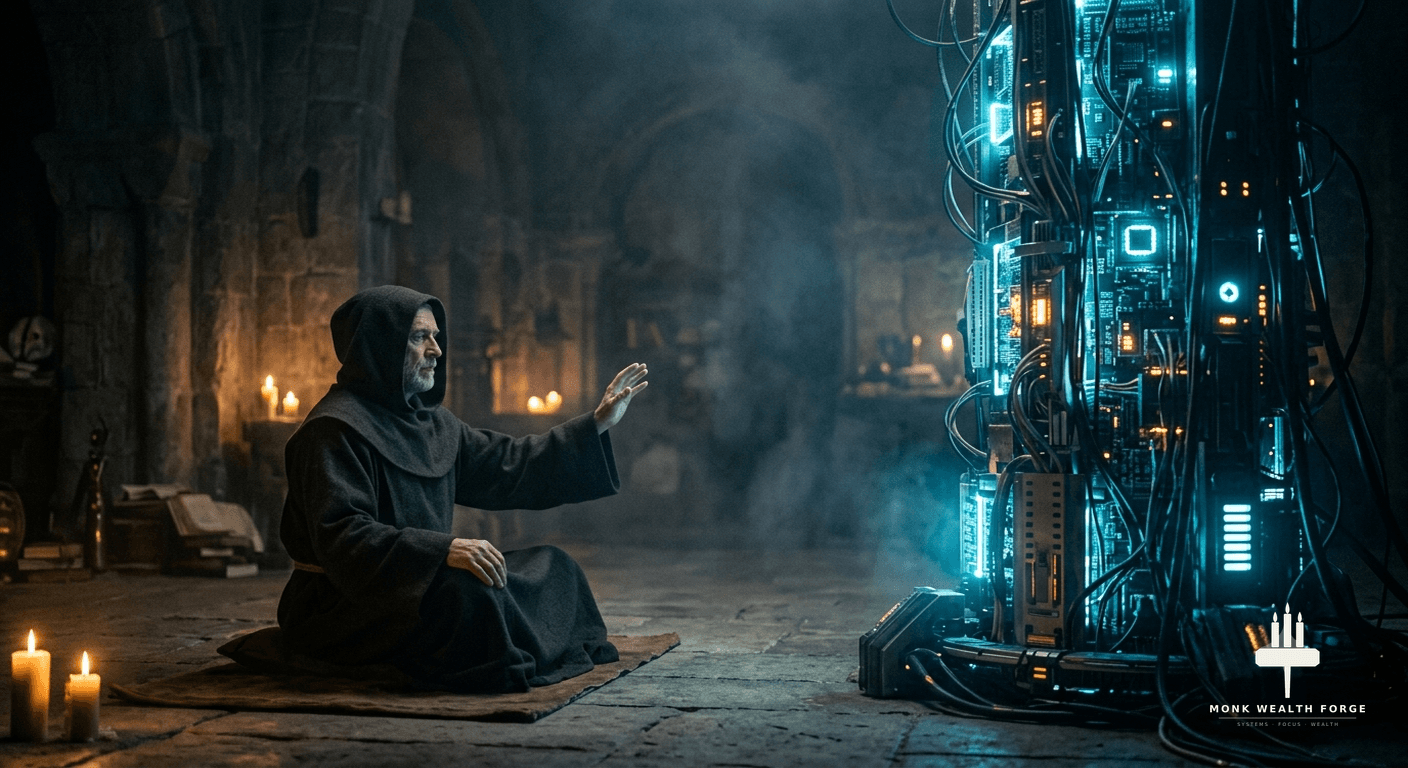
I didn't pick the monk framing by accident. I spent twelve years in religious education, and the one idea that stuck harder than any doctrine was this: the monk's security never came from the outside world. Not from a title, not from a patron, not from the times being good. It came from what he built on the inside. The discipline, the judgment, the refusal to let his center depend on conditions he couldn't control. Strip away the robes and that's just antifragility with a longer history.
The monk isn't safe because he found an untouchable job. He's safe because he built a self that doesn't depend on one.
While everyone else hunts for a career AI can't reach, the sovereign professional does something quieter and far more durable. He stops asking "what can I do that the machine can't" and starts asking "what can I direct the machine to do for me."
That's the inversion. The anxious majority sees AI as the flood coming for their little plot of land. The monk sees the same flood as force he can channel. Same water. Opposite posture. One drowns. One builds a mill.
This is antifragility in plain clothes. The fragile professional gets weaker every time the tools improve. Each upgrade eats another slice of his job. The antifragile one gets stronger with every upgrade, because better tools mean more leverage in the hands of someone who knows what to point them at. The technology that terrifies the task-doer is a raise for the outcome-director.
I rebuilt my entire site, rewrote every bio, and generated a full brand library in a single weekend using tools that would have replaced a version of me from ten years ago. They didn't replace me. They multiplied me, because I wasn't doing the tasks. I was directing them.
The Monk Wealth Forge Take
Stop asking whether your job is safe. It's the wrong question, and it keeps you fragile because it puts your fate in a title you don't control.
Ask the harder one: am I executing tasks, or directing outcomes? Am I waiting to be told the procedure, or deciding what the procedure should be? Because that answer, not your title, not the safe-list, not next year's chart, is what actually determines whether the machine works for you or instead of you.
The job you're trying to protect may not survive the decade. The posture will. Judgment travels. Taste travels. The habit of owning the outcome travels. Roles get automated; the person who directs them just picks up better tools.
Nine years financially free taught me this the slow way. My security was never one job, one platform, or one bet. Every one of those changed out from under me at some point. What carried across all of it was the posture: deciding what mattered, pointing my time and tools at it, and owning the result. That's the only thing that ever compounded.
If you want to start this week: take one thing you currently do by hand and force yourself to direct it instead. Hand the execution to a machine and make your only job the judgment. What's worth doing, and whether the result is good enough to put your name on. That discomfort you feel doing it? That's the muscle. That's the posture being built.
The monk doesn't fear the machine. He points it.
— Ken
Monk Wealth Forge | Radical Focus · Systems Over Hype · Stoic Wealth
If you want to build the posture, not just read about it:
I work 1-on-1 with founders and sovereign professionals to engineer exactly this: the shift from doing the task to directing the outcome, with the AI workflows and judgment frameworks that make you more valuable every time the tools get better.
View Advisory & Coaching Details →